
LONG-LASTING COATINGS
PROTECTING BUILDINGS & PLANET

Buildings Are Under Attack From Weather, Hazards & Aging
Green ENCASEMENT Coatings
Create Long-Lasting Protection Against All of It
Defending What You Have For Decades So You Don’t Have to Replace It


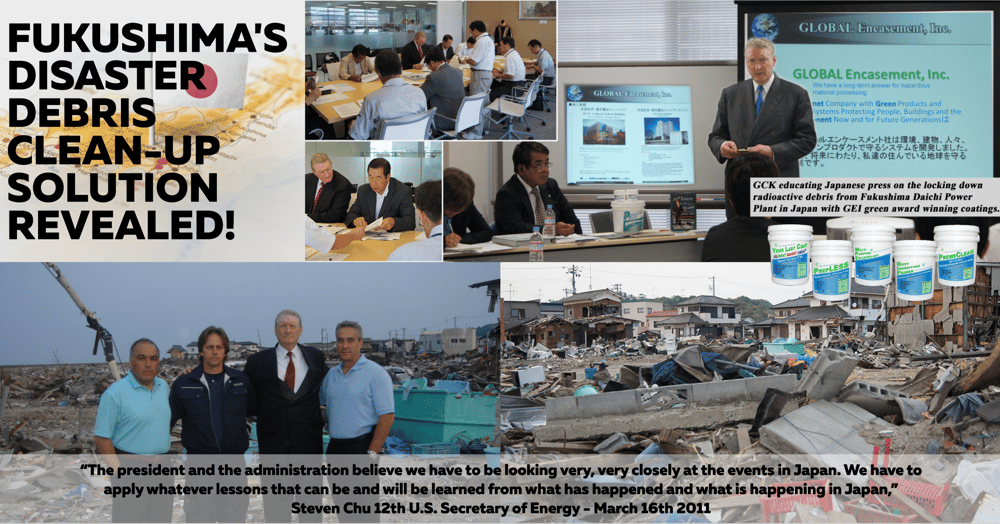
Fukushima's Disaster Debris Clean-Up Solution Revealed!
Monday, March 11, 2024
Listen and Learn: Dive into the Audio Version of Our Blog
The Fukushima nuclear disaster of 2011 left behind a daunting legacy of radioactive debris, posing a threat to both the environment and human health.
As the 13-year anniversary is on us, the world reflects on the devastation created by this catastrophic event.
However, amidst the ruins, an inspiration of hope emerges in the form of the right innovative, green coatings, offering a state of the art solution to lock down and contain the toxic aftermath.
In this episode I vividly recall the harrowing aftermath of the Fukushima disaster, a scene of unparalleled destruction and despair.
The sights and the quiet stillness after the destruction was penetrating enough but the thing that still lingers the most for me was the sickly smell from the rotting debris.
When called upon to lend my expertise, I knew the enormity of the task at hand.
Gathering a team of specialists from the United States and Japan, we began on a mission to devise a strategy to help contain the hazardous debris that littered the landscape and lend a hand in preventing dangerous secondary exposure.
Meeting in Tokyo we traveled to Fukushima, just outside the evacuation zone, where we presented and demonstrated our plan to the Japanese government and TEPCO officials.
Utilizing GEI's (Global ENCASEMENT, Inc.’s) environmentally advanced coatings, we demonstrated their effectiveness as tackifiers, encasing and sealing in the debris, preventing further contamination of the environment.
The sight of these coatings seamlessly locking down the rubble provided a glimmer of hope amidst the chaos.
As slight as it was in the magnitude of the situation, it demonstrated that certain parts of this disaster could be controlled.
Addressing concerns about the coatings' efficacy and environmental impact was paramount.
Through rigorous testing, accreditation and proven worldwide track record we provided irrefutable evidence of their suitability for the task at hand.
The coatings' green properties, including their biodegradability, low VOC’s and non-toxic content, reassured stakeholders of their minimal environmental footprint.
One crucial aspect of our solution was its resilience in the face of extreme conditions.
The coatings' ability to withstand movement and impact ensured their effectiveness, even in the event of fires or incineration—a critical consideration given the disposal methods for the debris.
We needed to prove that once the products we're covering and sealing over the hazardous debris they would not release anything toxic when being incinerated at disposal sites.
The same verification was needed proving that the coatings were biodegradable as burial was another method of disposal.
As we stand on the 13-year anniversary of the Fukushima disaster, it's imperative to acknowledge the progress made in containing its aftermath and how those same methods of control and containment are being used to help clean up and control secondary exposure in other disasters.
The deployment of GEI green coatings represents a triumph of innovation and collaboration, offering an ideal solution for a region scarred by tragedy.
To Sum It Up:
The journey to contain Fukushima's radioactive debris has been fraught with challenges, but through ingenuity and determination, we've discovered a solution that holds promise for the future of all cleanup from disasters.
With continued efforts and investment in green technologies and products like the right green coatings encasement, we can pave the way towards a safer and more sustainable world, free from the menace of the after effects of disasters.
“The president and the administration believe we have to be looking very, very closely at the events in Japan. We have to apply whatever lessons that can be and will be learned from what has happened and what is happening in Japan,” - Steven Chu 12th U.S. Secretary of Energy - March 16th 2011
What are your questions?
We are always here to help and excited to answer them.
Contact us at +1 (800) 266-3982 , or send us an email at service@encasement.com and leave a comment below.
See other posts like this one:











© Copyright 2026 Global ENCASEMENT, Inc. | ALL Rights Reserved